Aarhus to Zealand: ferry or bridge?
There are two routes east from Jutland, and neither operator compares them against the other. This page sets out the arithmetic, with every assumption shown.
Checked:
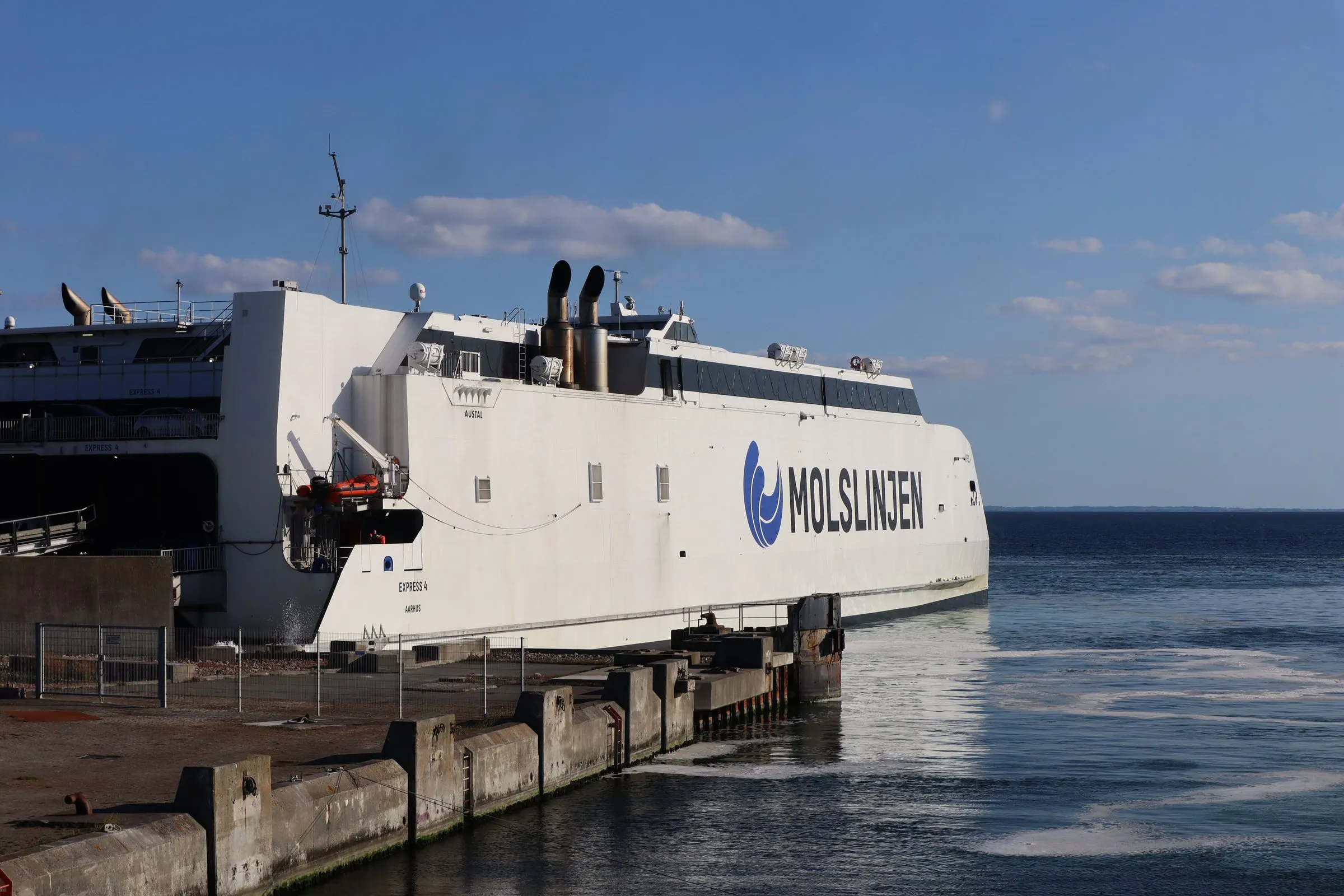
Molslinjen calls this crossing a shortcut: save 200 kilometres. Sund og Bælt publishes a toll. Neither puts the two routes side by side, and that is what we do on this page.
In short: the bridge wins on time, the ferry can win on money, and your destination decides which of the two matters.
First: are you already in Jutland?
Everything below assumes you have a car and are starting in Jutland. If you are not, settle that leg first: there has been no ferry from Britain to Denmark since Harwich to Esbjerg ended on 29 September 2014, so you cross to the Netherlands or Belgium and drive up, about 855 km from the Hook of Holland. If you are flying, note that Aarhus Airport is closer to Ebeltoft than to the Aarhus terminal, which points you at the seasonal Ebeltoft crossing instead.
The cost, with fuel counted
Ticket price alone does not tell the whole story. On the ferry you drive 188 km less, and that fuel belongs in the calculation.
Aarhus to Copenhagen, added up
One car with up to nine people, free-flowing traffic. The same start and the same finish, with three ways of paying for it.
Over the Great Belt Bridge
- TollBizz or number plate, 2026
- DKK 205
- FuelAbout 302 km
- DKK 302
About 3 hrs 20 min, all of it drivingDKK 499
Ferry, Lowprice fare
- Ferry ticketCar and up to nine people
- DKK 249
- FuelAbout 114 km
- DKK 122
About 3 hrs 45 min, of which 90 min not drivingDKK 360
Ferry, Standard fare
- Ferry ticketRefundable, rebookable
- DKK 524
- FuelAbout 114 km
- DKK 122
Same journey, bought late or kept flexibleDKK 646
The assumptions behind these numbers
- Petrol at DKK 15 a litre. Danish pump prices in August 2026 ran between roughly DKK 14.90 and DKK 16.70 depending on chain and region.
- Consumption of 6.5 litres per 100 km. A diesel estate, a full car or a roof box pushes this up and widens the ferry's advantage; an electric car narrows it sharply.
- About 302 km over the bridge. About 5 km from central Aarhus to the terminal in Østhavnen, plus about 109 km from Odden to central Copenhagen.
- Molslinjen's published from-prices for 2026. Lowprice moves with demand and sells out; on a summer Saturday it may not exist at all.
- No account of wear, parking, or the value of your own time.
The cheapest route depends on which ferry fare is available. A Lowprice fare booked in advance comes out roughly DKK 139 below the bridge and takes 188 km of driving off the trip. A Standard fare comes out about DKK 140 above it.
By destination on Zealand
Most people run the Copenhagen calculation. It is also the one where the ferry compares worst, because Odden lies 109 km northwest of the city. A different destination reverses the result.
Travel time by destination
Door to door from central Aarhus in free-flowing traffic.
| What we compare | Ferry via Odden | Great Belt Bridge |
|---|---|---|
| Copenhagen | About 3 hrs 45 min | About 3 hrs 20 min |
| Roskilde | About 3 hrs 15 min | About 3 hrs 10 min |
| Kalundborg | About 3 hrs 25 min | About 3 hrs |
| Holbæk | About 3 hrs | About 3 hrs |
| Nykøbing Sjælland | About 2 hrs 40 min | About 3 hrs 25 min |
| Rørvig and the Odsherred coast | About 2 hrs 50 min | About 3 hrs 30 min |
| Helsingør | About 4 hrs 5 min | About 3 hrs 50 min |
What we would doNykøbing Sjælland and Rørvig come out about 40 min closer by ferry than over the bridge. Holbæk is level. For Kalundborg, Roskilde, Copenhagen and Helsingør the bridge is quicker, even though you drive further. Route 21 is slower than motorway driving, so the kilometres from Odden cost more time than the same distance on the E20.
All the driving times above come from a routing engine on OpenStreetMap data, measured on 7 September 2026 with no traffic. Traffic can add significantly to these times. For the ferry we add 15 min to the terminal, 30 min for check-in and the 90 min crossing to the drive from Odden. Those times assume you make the sailing you booked, which is the ferry’s real weakness.
When the ferry is the better choice
Choose the ferry if
- You are going to northwest Zealand, especially Odsherred and Nykøbing Sjælland
- You can book a Lowprice fare far enough ahead to get one
- You are towing something: the ferry takes 188 km of motorway off the trip
- There are several of you: the fare covers the car and up to nine people, so a full car changes the cost per person completely
- You want a 90 min break from driving: coffee, a table and a walk on deck
Choose the bridge if
- Copenhagen or the airport is the destination and you are counting minutes
- You cannot say for certain when you will leave
- It is a summer Saturday and the lowest fares are sold out
- You are driving an EV, which reduces the ferry's fuel-cost advantage
- You need to travel outside ferry operating hours
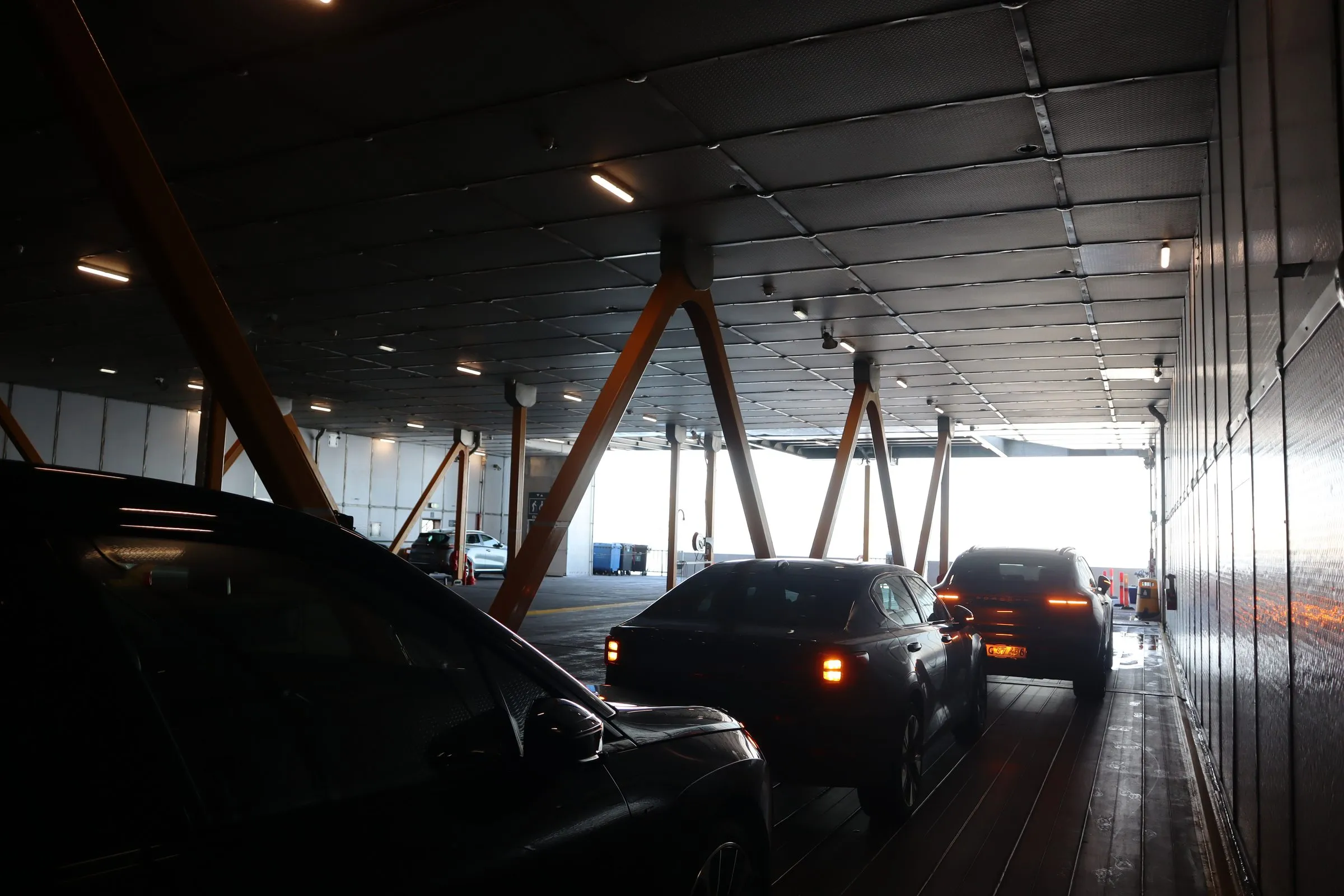
Campers, caravans and trailers
Height decides your fare. Molslinjen books by category: Car up to 1.85 m, Tall car up to 2.10 m, Van up to 2.95 m, and tall vans, campervans and buses up to 4.00 m. A roof box takes an ordinary car out of the cheapest bracket. Trailers are priced separately and by size: DKK 449 for one up to 3.0 m long, DKK 549 up to 5.0 m, DKK 649 up to 8.0 m and DKK 749 up to 10.0 m, on top of the vehicle fare.
Compare the totals rather than the headline fares: the trailer charge comes on top of the vehicle fare, so what you pay depends on which fare you got. Against the higher ticket, the ferry takes 188 km of motorway towing off the trip, and consumption with a caravan behind the car runs well above the 6.5 litres per 100 km used above. See vehicles.
The seasonal route from Ebeltoft
In the summer season there is a second crossing to the same port: Ebeltoft to Odden, about 75 min. If you are coming from Djursland or the north of Jutland rather than from Aarhus itself, it can be the shorter drive to the port. It closes for the winter; Aarhus to Odden operates year-round. See Ebeltoft to Odden.
Crossing without a car
The comparison does not apply: there is no pedestrian or cycle crossing of the Great Belt Bridge. The Kombardo Expressen coach drives aboard from Aarhus bus station and costs from DKK 109, and bicycles can be taken free of charge. See foot passengers and by bike.
Questions people ask
Is the Aarhus to Odden ferry cheaper than the Great Belt Bridge?
On a Lowprice fare, yes, once you count fuel. The ferry ticket starts at DKK 249 for the car and up to nine people, and you drive about 188 km less. On a Standard fare at DKK 524 the bridge is cheaper.
Is the ferry faster to Copenhagen than driving over the bridge?
No. Aarhus to central Copenhagen is about 3 hrs 20 min over the bridge. By ferry it is about 3 hrs 45 min, because you add the drive to the terminal, the check-in window and the 109 km from Odden.
When is the ferry clearly the better choice?
When your destination is in northwest Zealand, when you have a Lowprice slot, when you are travelling with a caravan or trailer that makes long motorway driving tiring, or when you would rather not spend 3 hrs at the wheel.
How much does the Great Belt Bridge cost with a bizz?
From 1 January 2026 the express price applies automatically with a bizz or number plate payment, without a separate Storebælt agreement. That is DKK 205 for a car, against DKK 235 paying cash or by card.